Optimism and creation

I'm still digesting Jason Goldberg's interview that I posted yesterday. I woke up this morning thinking he said something along these lines « there are two types of people; people who create and people who complain ». He might have said 'watch' or 'consume' instead of 'complain'. But I like that version better it's more dramatic.

It reminded me of the most useful rule of thumb I know: the 1% rule. This is not about the richest 1%. It's about the top 1% creators. It's about how only a tiny fraction of people create stuff (put things out there for discussions) and the rest edit, like, share or consume it. When you start thinking about this too much; you end up crazy like me and start a blog to even out your personal equation and try not to consume too much.

In Internet culture, the 1% rule is a rule of thumb pertaining to participation in an internet community, stating that only 1% of the users of a website actively create new content, while the other 99% of the participants only lurk. Variants include the 1-9-90 rule (sometimes 90–9–1 principle or the 89:10:1 ratio),[1]which states that in a collaborative website such as a wiki, 90% of the participants of a community only view content, 9% of the participants edit content, and 1% of the participants actively create new content. (wikipedia)

It also reminded me of being optimistic by default. When you hear new ideas, you always think about the upsides before the downsides. I was listening to an interview with Tim Draper this morning and they mentioned being optimistic got him into a lot of trouble. But also got him into a lot of great opportunities – like investing in Tesla or buying 20M$ worth of cryptocurrencies 5 years ago. Tim says when evaluating a new technology he's optimistic by default until he is proven wrong. This is certainly not a sustainable way of investing, running businesses or living your life. You can't be eternally optimistic and not care about the consequences.

But what if you simply act like you don't care? Think about it; it's not about the actual moves you make, it's more about the environment you set up around you. It's the conversations you start with friends and colleagues; the interest you have into others projects; the way you can brainstorm with no filter; the way you can throw ideas without being afraid you're wrong; the way you can create stuff knowing it might look stupid one year from now. All of this you can do without spending a single dollar. It creates a whole new world around you. It certainly draws people to you. And then, you can apply the pessimist filter. 

To create, you have to optimistic. To be an optimist, you have to constantly be creating.

And I believe you can work on these two things. It's like a muscle you can train. And the good news is, on this scale, you don't need a lot of money to be considered in the top 1%!

Bridging the gap between consumer & cryptocurrency

Jason Goldberg was featured on This Week In Startups earlier in October. The interview is over an hour long. It's honest and filled with a lot of information. If you want to learn about entrepreneurship, growing an e-commerce company too fast and bridging the gap between consumer & cryptocurrency, it's a good place to start!

Jason Goldberg used to run a great blog called BetaShop. I read it religiously in 2013-2014, when his company Fab.com was one of the world's fasted growing e-commerce company. The blog posts are down now but you can still find some pieces online. If you're interested in e-Commerce I suggest you google about Jason and Fab.com.

But if you want to see what a serial Internet entrepreneur thinks about the cryptocurrency's space. This interview is a must watch:

Pepo & Fab.com founder Jason Goldberg introduces Simple Token for apps to build branded tokens, bridging the gap between consumer & cryptocurrency. Jason G. walks Jason C. through what he calls the most exciting project he's ever been involved with, now being a pioneer in the decentralized web as he was in the early day of e-commerce.

Pepo & Fab.com founder Jason Goldberg introduces Simple Token for apps to build branded tokens, bridging the gap between consumer & cryptocurrency. Jason G. walks Jason C. through what he calls the most exciting project he's ever been involved with, now being a pioneer in the decentralized web as he was in the early day of e-commerce. With crypto can we finally fulfill the "power to the people" promise of the 1990s internet? The two also talk founder resiliency, soaring highs & devastating lows of entrepreneurship, Nick Denton & defunct Gawker, the dangers of raising too much money, the joys of living in Berlin, and much more.

About « clients »

I loved this article by Aaron Starkman on how to be a decent partner in a marketing agency.

His first advice hit me right in the feels.

Don’t refer to human beings as “clients.”

“Client” is a dirty word. No good comes from saying it internally. These human beings have names attached to them. It’s usually something like Chris, Margaret, Asif or Jackie. When discussing brand partners internally, you could say: “Robin really needs our help on something.” Or you could say: “Client is mandating that we do X, Y and Z.” The former statement encourages the team to help someone who really needs it. The other unnecessarily vilifies them and encourages resentment and annoying trash talk within your agency. And that almost never gets you to a great solution fast.

That's the number one thing that struck me when I started working in a marketing agency, after spending 5 years in other kinds of organizations. Marketing agency folks tend to spend way too much time theorizing about « their clients ».

The way they use the word is ridiculous. The client is just someone who's running a business, selling stuff and he/she needs services from you. But most of the time, most of the economic value is captured by his/her business selling stuff to consumers; and you're like 1/10 of the equation.

So don't get caught up in the game, the whole agency-client world we've created is just advertising people dramatizing their own industry.

It makes it almost romantic.

You come back at night and you tell your epic stories you had while fighting with « the client ». It feels like a bedtime story ad veterans tell youngsters to keep them on the edge and motivated. It's like having a common enemy makes the group stronger.

But all of this is like thinking the Earth is the center of the universe. It's just not healthy.

It's an unbalanced relationship because marketing services are 1/10 of what's on « your » client's mind. So while you spend 40h/week wondering what they think, and vilifying their intentions, they're up to other things; they have a business to run. You should be running your business too, by the way. The concept of customer obsession is not customer psychoanalysis.

And when you join your friends at night that don't work in advertising. They have no idea what you're talking about when you say « ah, this client is so bad ». It doesn't mean anything. It's just advertising lingo that keeps people uninterested in your work. And it doesn't spark good discussions. Try « X company is challenging to work with, they're growing fast because since they acquired Y and have a very particular org structure that makes producing Z for them hard. »

Aw, welcome to the real world. Feels good.

Finally, I find it alarming when people say « I'd like to work client-side ». There's no client-side. Client-side of what? You have non-profits, B2C businesses, and B2B businesses. Some sell products, some sell services. The world does not revolve around the relationship between an organization and its marketing partner.

  • Maybe you'd like to join a non-profit to see what fundraising is like.

  • Maybe you'd like to join another services company to learn new processes/skills.

  • Maybe you'd like to join an e-commerce company to learn about online sales.

  • Maybe you'd like to join a product company to learn about inventories and distribution.

But this is not « client-side », it's just another kind of business.

Clients. No good comes from saying it internally.

Data

I like reading Tom Goodwin. He makes me smiles. He sparks good discussions. I agree with a lot of what he says. I particularly liked this post. I'm reposting it here in its entirety because it's really good and there not much I'd add to it.

I'm not sure why we value data so much.

1) Today you can find data ( or frame data) to support any argument you wish to make.

2) Vast amounts of data we capture today has such flawed methodology it's worse than useless. It's not unhelpful, it's dangerously misleading. 

3) Both of these issues become even greater over time as we have more data, have less data literate people, and we've a culture that doesn't value critical analysis.  We really need to shift our focus to empathy and imagination, not what data says.

Data showed that Red Bull would flop, that people don't want smartphones, that 3D TV's would be the next big thing, that people won't pay for content and that Hillary would win.

We've become blinded by it on the false believe it's ambivalent, that it's objective, when it merely reflects the chaotic nature of the world and the objectives of those who recorded and spread it.  Even finding data to support an opinion is most often a matter of how much dedication you have, not what's real.

Source: Tom Goodwin, Linked In

It makes me laugh because I am ambivalent about data. When I put my M. Sc. Marketing hat on, I use a lot of it. When I put my entrepreneur/creative hat on, not so much. I think it's good to switch your brain between these two modes.

Digesting a lot of data (reading, experiencing, observing, not just stats) is great to feed your gut feeling and help you frame problems. But sometimes, you have to take a leap of faith and decide you'll go for something, even if you don't have all the data supporting you.

Remember: hundreds of years ago people crossed the Atlantic Ocean with wooden boats. They didn't have a lot of data to guide their decisions. They read, experienced, observed. And they were able to do great things.

There's no point in running linear regressions to know what you Cupcakes brand will post today on social media. Let it go.

Foursquare, the app or the company?

I saw this tweet today and it made me smile:

Foursquare, as an app, is not extremely popular these days. Foursquare, as a company, is thriving.

I wrote a thesis on using geosocial applications in 2011 when the app was booming. I was fascinated by the phenomenon and how « kids » used their cellphones. So the app always had a special place in my heart. A few persons I know still use it and find a lot of value in it. I look like a genius when I travel with it.

But the point is there's a difference between a company and a product. And Foursquare, the app, was just a product. Foursquare company, unlocked its potential as a company with the arrival of Jeff Glueck a few years ago.

If you have never read about the pivot of Foursquare, I suggest you dive into Jeff's Medium archives. I wrote before about miscalculating a total addressable market and I think detractors of Foursquare, the app, never truly understood the market Foursquare was in. Their new CEO definitely understood it. Here are two quote from him:

From the first day I joined Foursquare, I understood that our company should rightfully become the leader in location intelligence — we weren’t there yet, but we were on the road. That’s all crystallized in the nearly three-year journey since my first day. Now we’ve launched several products across various enterprise and advertising business lines, from measurement to ad targeting and of course our apps.
What a lot of people don’t realize about Foursquare is that our technology & mapping data powers features for leading companies such as Snapchat, Samsung, Microsoft, Apple Maps, Tencent, Twitter, Pinterest, and more. That B2B tech platform is a big part of our business, along with location-smart advertising that over 50 of the top 100 US advertisers use, measurement solutions, and analytics.

This is a good reminder that we fundamentally misunderstand most of what we see.

Read more

Trust The Process

I keep saying this these days. Trust the process.

The saying might have a special connotation for Basketball fans. There's a story about how a crazy manager turned the Philadelphia 76ers into a winning team after three years of losing on purpose. The coach had asked the investors, fans and players to trust the process. And it worked.

I mostly use it when talking about strategy or creative. There's a painful process in both disciplines. It feels a bit like a hype cycle, to be honest. There's a trigger (a brief), a peak of inflated expectations (the first meeting), a trough of disillusionment (the first 5-10 hours working on the brief), a slop of enlightenment (usually after a fruitful group effort) and a plateau of productivity (producing the material required).

Gartner

In the past years, I met a lot of young analysts, strategists or creatives that have a hard time going through the trough of disillusionment. You have to keep on writing, keep on reading, keep on drawing, keep up bouncing ideas with colleagues, keep on sketching, even if nothing good comes out of it.

You have to embrace that uncertainty, that feeling that you'll never land on something interesting. Trust the process. Remember what Picasso said:

Inspiration Is for Amateurs—The Rest of Us Just Show Up and Get to Work
— Pablo Picasso

I'm fond of creating bridges between marketing and investing. And I've seen the investment space, venture capital to be precise, described as a process too. A process you needed to trust. This is Andy Weissman describing his job:

What if the role of the venture investor is not to predict the future. What if the job is to develop a process to evaluate enormous amounts of data and ideas(quantitative and qualitative), collaborate on making decisions with that data, and then choose a set of investments which represent different possibilities for the future.

I love the closing remark:

Human nature and ego ask us to change course when things don’t appear to be working. The process, however, requires us to keep going.

When things don't appear to be working, the process keeps us going.

The New General Electric

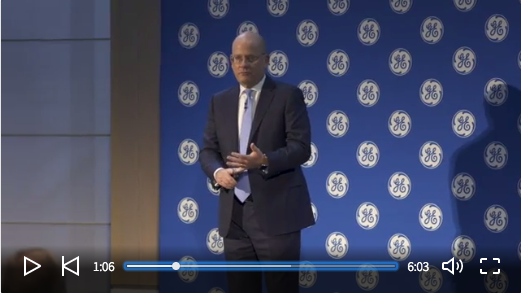
General Electric is often cited in the marketing-communications world as an example of its use of social media. But behind the colorful Instagram posts is 125 years old giant that is trying to re-invent itself. The company is currently in the midst of a turnaround, including a well documented digital transformation, with new CEO John Flannery trying to re-focus the giant conglomerate.

Today, John Flannery outlined plans to make the company stronger or as he puts it — a highly focused industrial company with unmatched global scale and strength. He said 2018 would be about focus and execution. I hope the previous years were too ;-)

I'm pouring a cup of coffee and watching the talk to see if I can cut through the investor's relations team fluff and learn a thing or two about strategy. If strategic planning is about making complex things simple and actionable, John Flannery has a lot on his plate.

p.s. presentation and keynote geeks, note that the PDF is available here.

p.s.2. social media geeks, note that the webcast is exclusively available on Linked In via John Flannery's personal account. I think it's a great example of Linked In being useful and relevant in a business context. And a great example of GE being very 'social' and 'personal'.

A Little Too Easy

Time and focus is a zero-sum game. I've spent a lot of time working on music-related things these days and less time writing this blog. I wrote about The Music Industry And Its Value Gap last week because my mind was in music mode.

When John, François and I sat down to talk about filming a video clip for The Moonlight Club's first album, we faced the challenge of having no money, little time and little resources to make it happen. Instead, we focused on what we could do with our resources (see minimum viable content creation).

So instead of spending 6 months filling papers for a grant, we rented a photo studio for 300$, brought our music equipment (and some of my own apartment's furniture) and set out to film the damn thing ourselves in one day. OK, it helps that Francois is a talented videographer and content producer ;-)

Here's the result. We're quite happy with it. By the way, you can find the song everywhere on Spotify, Apple Music, Soundcloud, etc.

It's much easier when you're into it

I've fallen behind on my blog posts so this is a re-edition of an old bit of writing I did in 2013.

Technology makes it really easy to start projects. We’re often tempted to jump into projects that seem like good ventures. In reality, it’s pretty hard to work every day on stuff you do not like. I’m not talking about a regular job where you get paid well, learn a lot and have a good team. These things can compensate for working in industries you like a bit less. I’m talking about projects you’ll end up spending your Saturday nights on.

I think there are a few good exercises to test your resilience and see if you can sustain beyond the hype and excitation of the first days:

  1. Write one short article (250 words) a day about that topic, during 2 weeks.

  2. Then go talk to 5-10 persons that are really into that stuff. See if you get along with them.

  3. And if you have some pocket change, buy 5-10 products related to that venture.

  4. Take days off and travel to an event related to your idea.

  5. Work for free, do 5-10 unpaid projects just to meet people.

You see the point. It will take years, not days, not weeks, you better enjoy the process.

Thesis Driven Marketers

I've written before about gaps between marketing and investment ( see The strategist's deal memo). Since they have similar objectives (growth), I think one can learn from the other. 

One time that struck me when I started reading about venture capital is that a lot of firms have an investment thesis. I didn't study finances and was never interested in investment before. I thought there were investors with money and companies with business plans. And they met halfway, in the marketplace. I didn't think a clear investment thesis allowed investors to focus.

Here's Brad Burnham from Union Square Venture, describing their 2011 investment thesis in a tweet:

How many marketing agencies or services firms describe their practice with that level of precision? And in 140 characters.

Capital is relatively less abundant than marketing services. There's almost no incentive for a marketing firm to develop and communicate a clear thesis about its services. An investor needs to develop a thesis that allows him to focus – to say no more than to say yes. A marketing agency needs to develop a thesis that appeals to a lot of clients.

But I still think developing a thesis and communicating it (the important part) can be extremely powerful. The thesis can and should be updated. Here's what Fred Wilson, again from Union Square Venture, had to say about this:

The thing about our investment thesis it that it evolves over time. We stick to it but we evolve it. And we do it consciously. Writing it down forces us to be clear in our thinking and draw distinctions that matter.
— Fred Wilson

Obviously, not all investment firms do that. And a lot of marketing agencies have a pretty clear vision that they articulate and communicate well.

But I think the gap is real: thesis-driven marketers are not as common as thesis-driven investors.

Get Bored

This is a quote from an article titled What Boredom Does to You:

Boredom is the gateway to mind-wandering, which helps our brains create those new connections that can solve anything from planning dinner to a breakthrough in combating global warming.

Unless you are on the manager's schedule, you need unstructured time during the day. Personally, boredom is my only effective strategy to writing music. There's no way I can write music with a busy mind. I need to reach the bottom of my thoughts to start writing music. And I never really start writing music, my mind starts wandering and does it for me. It's the same for any creative work in a professional environment.

That's also why writers, designers, programmers are known to arrive late at work or tend to be productive at night. It's not that they don't want to work, they're unconsciously trying to avoid busyness to start thinking clearly.

It seems to be true for kids too. Boredom encourages imagination.

Daydreaming is crucial to our mental health, to our relationships, and to our emotional and moral development. It promotes the skill parents and teachers care so much about which is the capacity to focus on the world outside our heads.
— MacQuarrie, 2014

So go ahead, get bored.

Inertia And The 5 Minutes Rule

I've read all the self-help books about habit creation, procrastination, and mindfulness. If you haven't, you don't need to. Here's the only thing I'd care to share: the 5 minutes rule. It comes from Kevin Systrom, CEO of Instagram. But it's not a novel idea.

If you don’t want to do something, make a deal with yourself to do at least five minutes of it. After five minutes, you’ll end up doing the whole thing.

5 minutes is usually what it takes to go from dreading doing something to loving doing it.

I use that in meetings. I'm an introvert so I don't love meeting new people. I always make a deal with myself that in 5 minutes I'll feel cool about it.

I use that in presentations. Again, I don't love to speak out loud in front of people. But after 5 minutes, I get caught in the game and start to enjoy it.

I use that for deep work. When I have a big research/writing project to do, I open a Google Doc and try to put a few things in there to get the engine going. After that, the inertia keeps me going. Inertia is useful and works for you.

Inertia is defined as the tendency of objects to keep moving in a straight line at a constant velocity.

This works well for daily tasks. But I don't think it applies well to bigger things in life. I think there should be a 5-week rule for new relationships, a 5-month rule for new jobs and a 5-year rule for tougher, longer-term projects. Start by doing it, and re-assess if you still dread it after that. You might catch yourself liking weird-tough stuff such as going to school, working, exercising or practicing piano.

p.s. the 5 minutes rule is the only way I can write these blog posts every day!

The Music Industry And Its Value Gap

This is a short video I posted on The Moonlight Club's Facebook page. With my friends John & Frank, we've been working on an album project. This is a video teaser of the first song we'll release this week.

When I shared the video posted on my own Facebook page, I took the opportunity to ask my friends how they listen to music. Without any surprise, most of them use streaming services such as Spotify, Apple Music, Google Play or YouTube. Some mentioned being vinyl collectors.

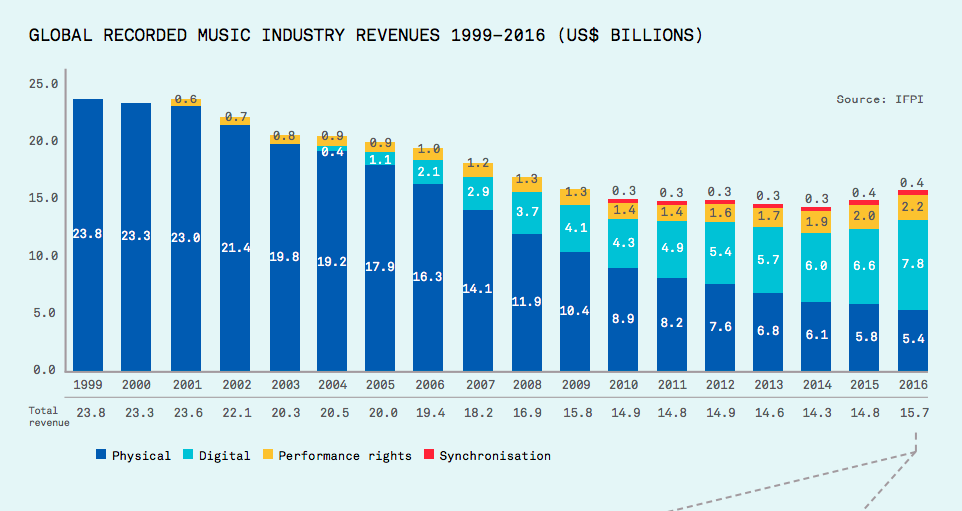
This is quite consistent with what the stats found in the IFPI Global Music Report. More digital revenues. Less physical revenue. Better monetization of performance. More synchronization (selling songs to ad/commercial properties). Interesting fact: before seeing a return to growth in 2015, the global recording industry lost nearly 40% in revenues from 1999 to 2014!

source: IFPI

source: IFPI

The most interesting thing in this report is without a doubt, what the IFPI calls The Value Gap. From publicly available data, IFPI estimates that Spotify paid record companies US$20 per user in 2015. By contrast, it is estimated that YouTube returned less than US$1 for each music user.

The value gap describes the growing mismatch between the value that user upload services, such as YouTube, extract from music and the revenue returned to the music community – those who are creating and investing in music. The value gap is the biggest threat to the future sustainability of the music industry.

When you read this, you think ' when we figure out how to extract that other 19$ from YouTube users, all artists will be rich!'. But you know by the time YouTube's revenue/user goes up, there will be a new platform that enlarges the value gap again. We want to look at graphs and see the bars growing year-over-year but I think digital music will always struggle at producing direct revenues for artists. Music is content. Content is consumed online. Online content (in general) has a hard time figuring out how to monetize itself. We're chasing our tails here.

I think the problem lies deeper. The music industry too many value gaps. There are many cases where artists provide value to an audience and are not compensated. Some industries are more efficient than others at capturing value. Maybe it is that artists are doomed. 

Maybe it's just that the industry hasn't found the right way to capture the value it produces. Maybe the industry doesn't even understand what it's really selling if selling is still an objective. 

Remember, Starbucks sells 5$ lattes to people who just want to hangout 1hr in a comfy sofa. Talk about capturing value. I think it's time to re-think value in the music industry. Ideas for that in another post!

Playing Video Games

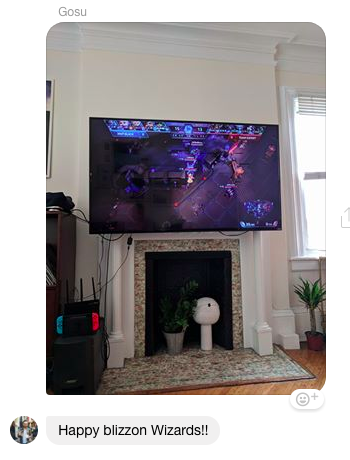
My friend Alex sent us this message today:

blizzcon

What's going on here? Well, BlizzCon is happening today! BlizzCon is a video game convention held by Blizzard Entertainment to promote its major franchises Warcraft, StarCraft, Diablo, Hearthstone, Heroes of the Storm and Overwatch (wikipedia).

You can stream much of the action online via Twitch. I didn't do that today. But 2 years ago, three of us gathered in an apartment to watch video games all day. Three grown-ups with adult jobs planning meals and drinks around a video game event. Well, we had a blast. And it was a great way to socialize around something light. Oh, wait... isn't it what sports fans do? Yes.

So I'm quite long eSports (it's not a stock, I know...). Not because I play much video games. I used to, though. And that's exactly the point. The games I grew up playing are now being played by world-class players and the games broadcasted for free. The casters are good, funny and smart. The production quality is almost as good as big sports. And all the stats are instant. And it's a lot of fun to watch with friends.

I think video games, and consequently eSports as entertainment, is vastly underestimated. When you think about it, you don't even need stats to understand why. Because it's socially unaccepted to be a video games enthusiast. It's the opposite of something that goes viral. You have no incentive to tell someone you play/watch video games. So people gather privately, or online. But the communities are growing organically, year over year. And it's getting harder and harder to ignore it.

I'll write about eSports from an analytical point of view in future posts. For now. I just wanted to wish a good BlizzCon to all the players and watchers out there.

And maybe plant a seed in your head so you go and google stats about eSports!


Total Addressable Market

I once applied for a job where they asked a time you encountered a promising seed-stage startup. I decided to tell the story I heard about GENIUS.COM and completely misunderstood it's potential. I was young at that time and didn't think the same way I do now. I had a limited number of words to explain the story so I kept it simple. Here's what I wrote:

One of the most promising seed-stage startups I’ve seen was GENIUS.COM. It was the first time I heard about startups. I was only a student lurking poker forums online when I read a post by a pro player who decided to invest money in a friend’s startup that focused on providing analysis of rap lyrics. I thought it was a terrible idea; a small market and unappealing niche. 

I was wrong. It turns out early users were obsessed with the product and the startup eventually pivoted to annotate the whole internet’s creative work.

I learned two things watching the company grow: 1) it’s better to have 10 passionate customers than 1000 who don’t care about you and 2) you need to ask the right questions when estimating a market; rap songs analysis and creative work annotation are two different beasts.

In this case, the company was addressing a far bigger field that I thought. I misjudge their total addressable market. I just used GENIUS.COM to look up facts about Morrissey's Everyday Is Like Sunday. It made me think of that story.

The Death of the Personal Blog

When I started writing this blog, I was very aware of the irony of starting a personal blog in 2017.

38 Likes, 2 Comments - Francois Royer Mireault (@frankmireault) on Instagram: "Ma *vielle* amie @msdesormeau et ses partners chez Hox Académie font avancer les choses en gestion..."

Today I was having lunch with my friend and ex-L'Oréal colleague Marie-Sophie Désormeau. She runs HOX académie in Montréal. They focus on digital education and transformation, without all the buzzwords, and with a lot of operational and managerial experience. Here's a photo I took of their business card.

Marie-Sophie told me she liked the blogging approach I took but had many questions about it. She was wondering why I was using my own platform (vs Linkedin for example), what was the content strategy, etc. I told her I didn't think about and I'd write about it.

First, my objectives with blogging are very different from what brands, personalities or public speakers might have. My goal is not real, engagement or conversion. My goal is to write every day, develop my English writing skills and wrap my head around new topics.

My strategy would be a disaster from a marketer's perspective.

I don't have a brand. I didn't create a custom website that represents my brand image, values, etc. I write on my own domain via Squarespace because I like to control the environment. I chose it because it's easy to write on it. There's little customization I can do. But I like to mess around with the software and play with a bit of HTML. It's good enough to get me excited about writing every day. And I'm not afraid someone else will change it.

I don't have a content strategy. I write about things I care about right now. It is focused on strategy, marketing, digital and entrepreneurship. But I can talk about design, arts, money, culture, etc. The content strategy is what's going on in my mind. It will be and should be different in 6 months. It is a bit messy but it works for me.

I don't have a distribution strategy. I post here every day, tweet the articles on my personal account and post once in a while on other platforms. I curate some articles I like and put them on Medium. But I'm not tapping into the power of huge publishing platforms such as Linked In.

I don't have conversion goals. Except clarifying my mind and drawing interesting discussions on few topics I care about. I set up a newsletter opt-in but I'm not sure what I'll do with that.

So no, I don't recommend everyone/every brand start a blog. It is kind of a thing of the past. But it works for me. It is my daily meditation.

Also, I'm thinking about what I read personally and I realize I always end up on the same few blogs. I don't really care about magazines, generic publications or newspapers. I care about what people think. I like to discover and meet people. So I guess I'm trying to do the same here.

Finally, here's a quote that captures the idea of this post:

I don’t read blogs just for information — I read them to get to know the person over time.
— Semil Shah

Scheduled Unproductivity

There's a classic blog post by Paul Graham titled Maker's Schedule, Manager's schedule. If you've never read about this concept, I suggest you do it. It's a very good framework for understanding two fundamentally different ways of working. The whole article is about the intersection of these two types of schedules and how to deal with it. Here are some the highlights:

About the manager's schedule:

The manager’s schedule is for bosses. It’s embodied in the traditional appointment book, with each day cut into one hour intervals. Most powerful people are on the manager’s schedule. When you use time that way, it’s merely a practical problem to meet with someone. Find an open slot in your schedule, book them, and you’re done.

About the maker's schedule:

But there’s another way of using time that’s common among people who make things, like programmers and writers. They generally prefer to use time in units of half a day at least. You can’t write or program well in units of an hour. That’s barely enough time to get started. A single meeting can blow a whole afternoon, by breaking it into two pieces each too small to do anything hard in.

One solution Paul suggests to deal with the manager's schedule conflicting the maker's schedule is office hours. It's funny because it obviously reminds you of school. Profs have office hours. Well, it makes sense. Schools are supposed to be filled with students on a maker's schedule. 

How do we manage to advise so many startups on the maker’s schedule? By using the classic device for simulating the manager’s schedule within the maker’s: office hours. Several times a week I set aside a chunk of time to meet founders we’ve funded. These chunks of time are at the end of my working day, and I wrote a signup program that ensures all the appointments within a given set of office hours are clustered at the end.

Paul writes this about speculative meetings. Or coffee dates. Which I love to do. Both because I'm curious and because I love trying new coffee spots.

Speculative meetings are terribly costly if you’re on the maker’s schedule, though. Which puts us in something of a bind. Everyone assumes that, like other investors, we run on the manager’s schedule. So they introduce us to someone they think we ought to meet, or send us an email proposing we grab coffee. At this point we have two options, neither of them good: we can meet with them, and lose half a day’s work; or we can try to avoid meeting them, and probably offend them.

This week, I schedule all my meetings Friday. That way I know that Friday won't be productive. But at least it's scheduled unproductivity. It's not always possible

I'm a strategist and I like to schedule days in chunks. One big thing in the morning. One big thing in the afternoon. Sometimes, nothing happens for an hour, and everything happens in the next 15 minutes. Scheduling in chunks of 3hr+ is the only way for me to achieve anything.

I think it's good to be aware of this concept. If you're on a maker's schedule, try to protect yourself from people on the manager's schedule. Otherwise, you'll feel unsatisfied at work. If you're on the manager's schedule, think about it when you book 15m meetings with a creative/tech person at 10h15 in the morning. Assume you always take 3hr of their time.

Minimum Viable Content Creation

9 Likes, 1 Comments - Francois Royer Mireault (@frankmireault) on Instagram: "Lunch date 💯"

I had lunch with my friend Jeff, who's one of the best content creators I've met. He was saying what Gary Vee is saying now, 5 years ago. He likes to dress like Tom Cruise in the movie The Firm and we like him like that. This is him:

So we were talking about content creation.

He creates lots of it as a real estate agent. He does it under the brand Tower Trip.

I create lots of content too, along with my bandmates, for our music band The Moonlight Club.


This is us doing our thing:

137 Likes, 5 Comments - THE MOONLIGHT CLUB (@themoonlightclub) on Instagram: "🎥 coming soon!"

We do it all by ourselves. Not because it's cheaper or easier. Because it would not make sense otherwise to outsource content creation. We don't start with a finished product in mind and outsource the parts to different experts – we do the best we can do with our skills and tools. So what we do is minimum viable content creation. It's not perfect. But it's out there.

So what we do is minimum viable content creation. It’s not perfect. But it’s out there.

Why? Because it's better to do something than nothing. When it comes to content creation, you should start by doing what you can yourself and build from there. Because if you can't do it yourself - or understand the process - there's no way you will be able to scale the process.

We often bring the quality/time/price dilemma in advertising. For content creation, I'd optimize for time and price, and count on the fact that repeated actions - the velocity that low cost and production time allow - will undoubtedly increase quality over a long period of time. The formula doesn't really work the other way around. You'll give up too quickly.

For content creation, I’d optimize for time and price, and count on the fact that repeated actions - the velocity that low cost and production time allow - will undoubtedly increase quality over a long period of time.

p.s. It's exactly the approach I have with this blog. I use Squarespace, rely on labeled for re-use photos and I don't proofread. Sure, I make mistakes and it's not perfect. But with the same effort/budget, I can have 10x more articles than if I'd outsource parts of it.

What is the Internet, anyway?

I love this video. It put things into perspective.

There are many things in the world right now that feel like the Internet in 1994. Bitcoin, along with cryptocurrencies and decentralized applications s one of them. So is machine & deep learning. e-Sports feel like that too. Autonomous cars too. Universal basic income too. Virtual reality too.

I'm excited about these things because no matter how bad we describe them today, they might unlock a ton new opportunities tomorrow. 

There are more 'why?' and 'what?' and 'how?' than answers. But it is by talking and writing about them like these TV hosts are doing right now in this video that we begin to understand them. It's OK not to understand.