Starting as a beginner (and closing the gap)

A few years ago, I read a quote from Ira Glass (This American Life) about the difficulty of getting good at anything when starting as a beginner. I wrote it down on medium and it stuck with me ever since then. 

When starting as a beginner, you get a lot of resistance. First, you tell yourself your creative output is not good and you have no idea how will it be ever great like the people you look up to. Second, people you know doubt how what you're doing now will evolve into something great. And you feel like an imposter. 

What nobody tells people who are beginners — and I really wish someone had told this to me … is that all of us who do creative work, we get into it because we have good taste. But there is this gap. For the first couple years you make stuff, and it’s just not that good. It’s trying to be good, it has potential, but it’s not.

But your taste, the thing that got you into the game, is still killer. And your taste is why your work disappoints you. A lot of people never get past this phase. They quit.

Most people I know who do interesting, creative work went through years of this. We know our work doesn’t have this special thing that we want it to have. We all go through this. And if you are just starting out or you are still in this phase, you gotta know it’s normal and the most important thing you can do is do a lot of work.

It is only by going through a volume of work that you will close that gap, and your work will be as good as your ambitions.
— Ira Glass (This American Life)

I've lived through a few cycles of trying to « close the gap » now. First, as a snowboarder and wannabe filmmaker, second as a musician an wannabe record maker, third as a marketing professional and wannabe strategist, fourth as a first time investor/board member and now, again, as an entrepreneur.

Each time, it takes years. Each time, starting as a beginner feels weird. Each time, people around you are skeptical. Each time, you doubt yourself. But it's alright, you're a train passing by and people are standing still. Don't bother, just mind « closing that gap ».

Now, I love meeting people who have clearly not « closed that gap ».

There’s always someone, somewhere
With a big nose, who knows
And who trips you up and laughs
When you fall
Who’ll trip you up and laugh
When you fall
— The Smiths, Cemetry Gates

The strategist's deal memo

As a strategist working mostly on marketing challenges, I've always liked to draw inspiration from other fields to improve my own toolbox. In the past 5 years, most o the projects I've worked on were a consequence of companies being challenged online and wanting to be online leaders.

Venture Capital firms have been thinking about original and profitable ways of growing online companies for over 20 years and I've liked to read how they structure their thinking about new investments.

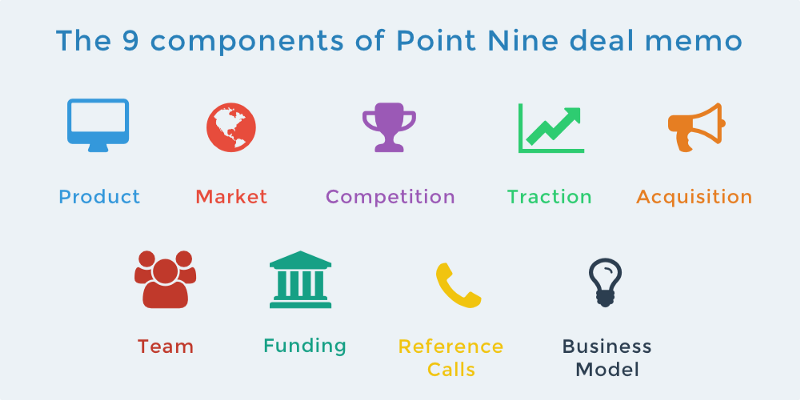
As an example, this is the open source deal memo template from Point Nine capital. 

The deal memo is a document we start to fill in whenever we take a closer look at a company. Its main purposes is to make it easy for the rest of the team to get up-to-speed with what the company is and to identify key points which have not been covered yet. We write the deal memo ourselves by collecting all the information we could get from the deck, conversations with the founders (email, meetings, calls), and also our personal research. (source)
(source)

If you compare that kind of deal memo to the briefs or whatever tool most communication-brand-marketing-or-even-business strategists use, you realize that some key elements Venture Capital firms think are essential to the success of a new online business are not part of most strategists reflexions. 

Product, market, and competition feel familiar. We're good.

Traction and acquisition are often overlooked because you don't have access to these metrics or people don't really understand where their customers are coming from. It's blurry.

The team is usually absent from a strategist's considerations. Who will execute the plan and what are their strengths and weaknesses?

Funding could be translated to a company's capacity to invest in growth. This is a relevant question: « How much cash is left in the bank and how much time it will last? ». 

Reference calls are quick 15mn calls with customers or industry expert. Not a research mandate by an external firm or interns. Not a fact pact. Just quick chats with people who are familiar with the product and can provide additional info.

The business model is the current pricing and how it compares to similar products.

Obviously, this exercise is a stretch. I don't think strategists should use VC deal memos as is.

  1. I do think most consultants are missing important info when they assess a mandate and that comparing with what VCs are looking at is a good reminder of the business's fundamentals.
  2. I do think there's value in using a standardized format like the deal memo to be able to compare projects over time. So I'll try to develop a strategist's deal memo in the future.


Concept stores

Concept stores have been around for a while. They're vaguely described as « shops that sell a carefully curated and unique selection of products that connect to an overarching theme (source) ».

I was getting my haircut this morning but a fine gentleman  that have been living in the Mile-End for 22 years. He says he dislikes that everything is a concept store nowadays. He misses the old, scrappy, non-descript shops of the area. I kind of agree with him. I'm OK with the mix of both. I don't think a place should only have one or the other.

Also, I don't think it's a good idea to start a business around a concept. A concept is not an end in itself. Concept stores and restaurants come and go. I think it's because customers, owners and consequently, employees, don't get really attached to it.

When we started the restaurant Le Buck, we were adamant that this was not going to be a concept restaurant. It's a vision we have and it translates into some conscious choices we make (food, service, ambiance, brand, etc.).

You get attached to a vision, not a pre-packaged concept. I try to avoid that word.

Reading has no rules

The Knowledge Project is a podcast by Shane Parrish, curator of Farnam Street Blog. In this episode, Shane interviews Naval Ravikant, CEO of Angel List and investor in too many startups to name them. It's about 2 hours long. It's a great conversation between two great minds. I like to listen on Overcast, the podcasting app. Here's the link to the episode.

What struck me Naval's comments about reading. He says that we should not treat reading like a competition. That a lot of people read too little because they're « stuck with this one book they can't finish ». He argues you should read a lot, all the time, not matter where and how, and not care about finishing or not the books. You can always re-read them, two or three times. Otherwise, reading becomes a burden.

If you ask people if they read, everybody says they read. Everybody says they’re reading a book. They can answer which book they’re reading. The reality is very few people actually read and actually finish books.

I think that’s probably because of all of these societal and personal rules that we’ve put up, like you must finish a book and you must read books that are good for you, and you can’t read junk food books. This is a hot book right now and so on.

The reality is I don’t actually read that much compared to what people think. I probably read one to two hours a day. That puts me in the top .00001%. I think that alone accounts for any material success that I’ve had in my life and any intelligence that I might have. Real people don’t read an hour a day. Real people, I think, read a minute a day or less. Making it an actual habit is the most important thing. 

Full transcript from Farnam Street

A New Decade

I'm turning 30 today and I decided I will be writing a short blog post everyday for the next ten years. Both as a way to clarify my mind and improve my English writing skills.

As a knowledge worker, whose main capital is clear thoughts, I find it alarming that I have time for social media but not for writing. I feel like an athlete who eats fast food and don't train.

I held blogs in the past, did 30 days writings challenges and tried different publishing platforms. I don't care how this one evolves – I doubt the Internet will look the same in 5 years – I care about writing everyday.

I've just started a new consulting studio called HIGHLOW and wrote the business plan on a 10 years horizon. Let's see how that goes.

We always overestimate the change that will occur in the next two years and underestimate the change that will occur in the next ten. Don't let yourself be lulled into inaction.